Figure
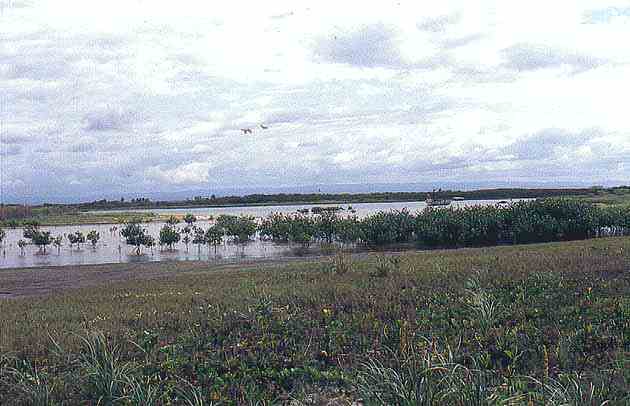
1. Swamp ecosystem in Port Pizarro, Tumbes-Perú.
Introduction:
The use of the sea like source of resources for the subsistence have been considered by the Andean people of South American from immemorial times. Inside the specialized literature, the study of the different remains that show the use and exploitation of the resources of the sea is denominated “marine subsistence”. This way, in this item are understood both vertebrates and spineless remains as: marine mammals, fish, birds, crustacean, algae, and of course, molluscs. These resources are continued exploding actively at the present time, maintaining industries and communities of traditional fishing (in ports denominated caletas) along of Peruvian coast.
However, some species of marine molluscs were appreciated, not only for their meat, but also by their size, it forms attractive and color of the shell that served as matter basic to make personal decorations and artifacts to the rite.
In Andean of Peru, approximately 4,500 years ago emerged the first big temples that organized to agricultural societies that counted among their main products to the potato (Solanum tuberosum), corn (Zea mays), yucca (Manihot esculenta), cotton (Gossypium barbadense), among others. Also, the temples produced the first artistic images that expressed their beliefs, captured in fabrics, gourds, figulinas of mud, objects worked in bone or lithic engravings. All this happened before the appearance of the pottery for what the archaeologists denominate to this period Late Preceramic or Archaic. In this context, the first indications of the presence of the Spondylus princeps are detected, one of the big molluscs of the Andean ritual that lives in warm waters of the Ecuadorian coast toward the north, arriving until the Gulf of California.
The Current Tropical Ecuadorian of warn waters reaches temperatures that fluctuate approximately between 24 and 29 °C. The waters of the Peruvian Current (Humboltd) they fluctuate between 14 and 18 °C. There are four types of beaches: swamp (“manglar”), sandy, sandy / stony and stony. The molluscs can live in the area of fluctuation of the tides, reef of the waves or in the marine funds (infralitoral).
|
|
|
Figure
1. Swamp ecosystem in Port Pizarro, Tumbes-Perú.
|
In Central Andean archaeological sites (Perú), there is a group of molluscs documented in contexts of no-subsistence that attracted the attention of pre-Columbian societies from the beginnings of the civilization in America for because singularity, rarity and beauty, in chronological order of appearance these they are:
The last two species are clearly identified here for the first time in Peru’s archaeology. They have their habitat in the Panamanian Province, for this reason they arrive in Peruvian Andes from the coasts of Ecuador (although the species Malea ringens, Strombus peruvianus, Conus fergusoni, Pleuroploca princeps and Fusinus panamensis reach to be distributed until the tropical sea of the Peruvian north). They became indispensable in religious and funeral rituals, and they constituted ornamental elements, distinction and prestige between shamanes and warriors, reinforcing the symbolic power of these members of the social elite. Between these big tropical molluscs, the Spondylus princeps played a main role, being very considered and object of intense traffic until Inca times (Rostworowski 1977; 1999).
Antecedents:
The use of the shells of tropical molluscs for the first residents of the region of the Ecuador (North’s Andes) goes back to Las Vegas culture, 10,000 - 6,600 B.P. The contexts and species that appears are:
a) Funeral: Anadara tuberculosa, Tagelus sp., Mytilus, Natica sp., Melongena.
b) Ceremonials: Murex, Melongena.
c) As material to manufacture:
- Trumpets “pututos”: Melongena
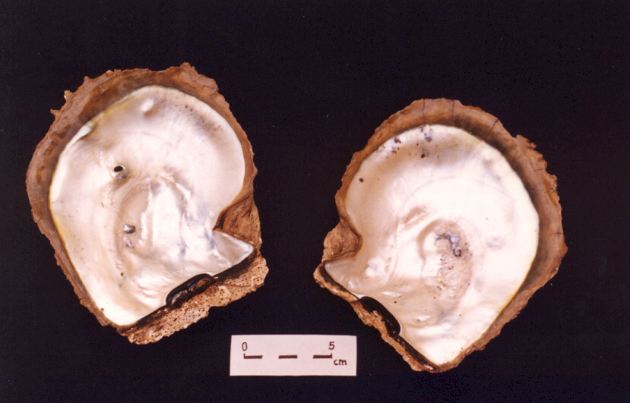
- Possible torteros or “piruros”: Pinctada mazatlanica
- Plates and tablespoons: Malea ringens, Lyropecten sp.
- Devices possibly used to dig: Melongena patula.
- Containers of substances: Malea ringens.
- Ornaments.
(Stothert 1990).
 |
|
Figure
2. Pinctada mazatlanica.
|
Later, the ritual use of big molluscs Spondylus princeps, Strombus peruvianus and Strombus galeatus related to the water’s cult in this region are located in remains of the Valdivia culture toward the 3,200 B.C. (Marcos 1995:99; Marcos 2002). Marcos thinks that several natural factors that created the relationship Spondylus -rain existed, these they are:
a) The recurrent rains and droughts of the coastal climate that it exists among the port of Manta (Manabí) and the Gulf of Guayaquil (Guayas).
b) The fluctuations of the currents of warm waters that offer good conditions for the proliferation of Spondylus in the infralitoral and the presence of rains with vegetal grow in this area.
c) El Niño phenomenon (ENSO, El Niño Southern Oscillation) that takes warm waters to the south of Tumbes and Piura (Peru) in coasts where it never rain and are always arid.
(Marcos 2002:15, 16)
Paloma, located at 8 Km. at the north of the gulch of Chilca, 65 Km. from the south of Lima city. It was established or occupied between 4,000 and 2,800 B.C. (Quilter 1989:6). Association of Spondylus is uncertain (Ibid.: 29).
Caral, located in Supe valley, 182 Km. at the north of Lima city. It was occupied between 2,627 and 2,020 Cal B.C. (Shady et al. 2001: 725). It was a bead tubular of Spondylus in constructive filler (Shady 2000: 60; Gorriti 2000:14, 18).
La Galgada, located in the Tablachaca river, county of Pallasca (Ancash department, nor-central mountain of Peru). Occupied among 3,000 B.C. up to 1,500 B.C. The Spondylus can be dated in 1,610 ± 700 Cal B.C. (Grieder et al. 1988: 93, 94, 69).
Los Gavilanes, to 2 Km. to the north of the Huarmey valley, nor-central coast of the Peru. Busy among approximately 3,200 and 1,600 B.C. (Bonavía 1982:277). The Spondylus was located in the phase 2 of Los Gavilanes 2,780 years B.C. (Ibid. :276).
The Aspero, at 1 Km. at the south of Supe’s Port, in the same valley. With radiocarbon dates that go back to 2,930 B.C. in “Huaca of the Sacrifices” and 3,702 B.C. in “Huaca of the Idols” (Feldman 1980: 246). A fragment of thorn of Spondylus was located in a sector at 100 m. at the north of “Huaca of the Idols” (Ibid. :157).
Kotosh, at 5 Km. at the west of Huánuco city, central highlands of Peru. The reference of the presence of Spondylus in this place is pointed out by Marcos (1995: 116; 2002:23). We have not been able to locate it. On the other hand, Burger (1992) neither mentions it in his revision of the Late Precerámico period and their relationship with the Chavín phenomenon.
Later, in Cupisnique culture (1,300-600 B.C.) from the Formative period (1,800 - 200 B.C), the Spondylus appears with more presence in:
a) Sculptural bottles of ceramic with representations of Spondylus and Spondylus-Strombus galeatus (Alva 1986:146).
b) Beads or "chaquiras" for the production of necklaces in funerals contexts.
Discoveries of devices worked in Spondylus in a tomb in Cerro Blanco (Cajamarca): There are square badges and beads that show bigger sophistication and care in their elaboration, one of the badges is decorated with a face of Chavin’s features (Terada and Onuki 1988: 6, Fig. 18, plate 6).
In Chavín of Huántar (1,200-400 B.C.) it appears as:
a) Fragments in the “Caracolas Gallery” of the “Old Temple” (Lumbreras 1,989:160), as well as it is represented in bone and lithic pins ( named "tupus"), besides a bead in the “Gallery of the Offerings” (Lumbreras 1993).
b) Worked in beads forms in the residential areas outside of the temples, prepared in group under the floor and in a contention wall, not in midden contexts. (Burger 1998:203,239).
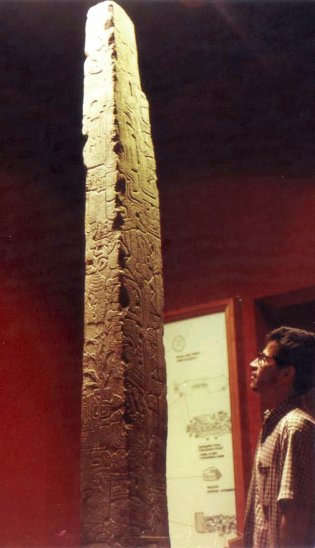
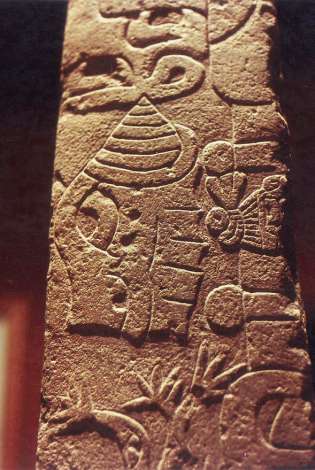
c) Represented among the engravings of Tello’s Obelisk. Also, a sculpture called the “supreme deity” that decorates the patio of the “New Temple”, takes in its right hand a Strombus and in the left one a Spondylus (Burger 1992:174). The small court of this same sector shows the figure of an anthropomorphic monkey holding a Strombus. Also, two characters recorded in stone that decorate the sunken circular square blow shell trumpets Strombus sp. or “pututos” (Burger 1992; Lumbreras 1989:164).
 |
 |
|
Figure
3. Tello’s Obelisk of Chavín de Huántar. Detail of the Spondylus and
Strombus designs.
|
|
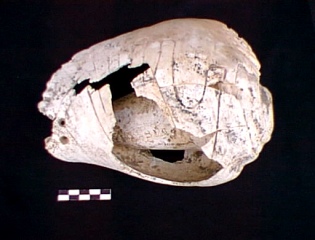
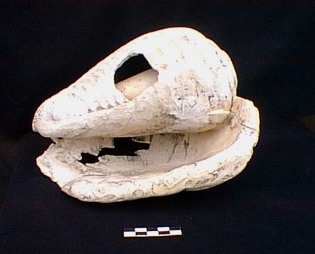
The earliest discovery of Strombus galeatus in the Andean region corresponds to a clipped refined and perforated fragment found in the Level IV of Telarmachay (age range C14 without range between 2,470-1,730 B.C.) (Lavallée et al. 1982:100). Another specimen was in the tomb of a woman sacrificed in Punkurí, located in the valley of Nepeña, nor-central peruvian coast (Tello 1967:68). Complete specimens of Strombus galeatus are recorded in:
a) Chiclayo, north coast of Peru: the “Strombus Pickman”, with chavinoid designs.
b) An almost complete specimen belonging to the collection of the National Museum of Peru, that has as decoration an open hand, perhaps pre Chavín style. Unknown origin.
c) Kuntur Wasi, Cajamarca, three complete specimens of the Tomb 1, one of them with decoration chavin-like (Onuki 1995:15.,16. Plate 7, 10 and 11).
d) The recent discovery of twenty specimens in the “Caracolas Gallery” of Chavín de Huántar made by John Rick (2001), whose antecedent was the discovery of some Strombus pieces in a previous excavation (Lumbreras 1989:160). Rick has affirmed that based on other remains of Strombus the number of specimens would have reached at 29 (Rick 2002). All these Strombus shells were used to manufacture “huayllaquepas”, “pututos” or trumpets, and they were intimately linked to the religious ceremonial of the Chavín culture (Burger 1992:200). It is necessary to affirm that, up to now, this is the biggest group of Strombus galeatus in the whole archaeology precolonial of Peru.
 |
 |
|
Figure 4. Strombus galeatus with pre-Chavín designs.
National Museum of Peru collection.
|
|
In accordance with the evidences, during the Formative both Spondylus princeps and Strombus galeatus were incorporate indeed inside the religion of these cultures, in such way that they were represented clearly, and in the case of the Strombus they were acquired all wholes. We can intend that the religious elite assumed them in all its meaning, making them transcend from objects that served like personal decoration or secondary ceremonial element, as symbols with quality incorporated to its religion. This feature would stay in different pre-Columbian societies in the Andes. Here we must indicate that after the Formative Strombus galeatus shells were rarely used to make designs or images.
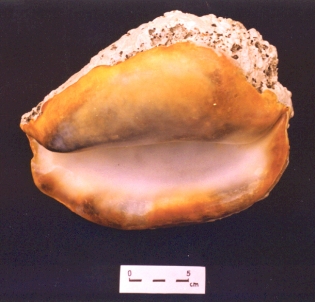
Also, in this period the discovery of two trumpets of Malea ringens is documented in a funeral context of Huayurco, a site located in the oriental hillsides of the Andean region (county of Jaen, north higlands of Peru), between the mountain and the low lands of Amazonia (Rojas Ponce 1969, lámina 2; 1985; Burger 1992:218). The Malea ringens is a specie that can be gotten in the current costs of Ecuador, however, its habitat can arrive until Sechura, in the northern Peruvian department of Piura (Alamo V. and V. Valdivieso 1987; the author’s personal observation 2001). This specie is not represented in the Formative iconography cultures in central Andes, and until now any discovery of this type has not been documented.
 |
Figure
5.
Huayllaquepas or trumpets of Malea ringens, National Museum of Peru collection. |
During the Regional Developments period (ca. 200-650 A.D.), the presence of Spondylus princeps valves, rectangular badges, necklace and fronts in funeral contexts of Moche culture is frequent. Also, the Strombus galeatus maintained its importance like an element represented in the iconography of this culture (Bourget 1990), however, we pointed out that it is not found as offering in funeral contexts.
In Lima culture of the central coast, scarce discoveries of Spondylus princeps are registered in circular and rectangular beads form, but it is not represented in the iconography. This only happens in sculptural bottles of the Nievería style, toward the beginnings of the impact of the Huari culture in the region (ca. 650-750 A.D.) (Gorriti 2000:15). In this sense, both for the quantity and for the representations, it is notorious the difference with the Moche culture. A singular example of Strombus galeatus comes from Huaquerones, a site with Lima occupation in the Rimac valley, however, the piece shows a figure with a clear filiation with Recuay culture, being able to be an exchange piece (Stumer 1957: 281, 284, Fig.14). On the other hand, in “Huaca San Marcos” (or Aramburú) of Maranga complex (one of the biggest center of Lima culture) there was a specimen of Strombus peruvianus, in a ventral face down position, in one of the holes of post of the colonnades of trunks in squares at the summit of the pyramid (Gorriti 2000). This is one of the strange specimens of this species found in archaeological contexts of the Regional Developments in Central Andes.
The similar case happens in others important sites of the south coast, for example, Cahuachi, great center of pilgrimage of Nasca culture where have been a dozen of pieces of Spondylus partially worked in the “Room of the Posts” (Silverman 1993: 178), also in the sector of “Old Town” there were badges of Spondylus associated to funeral contexts of the culture Huari (Gorriti 1992).
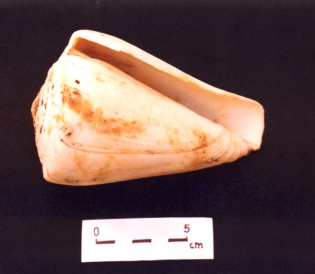
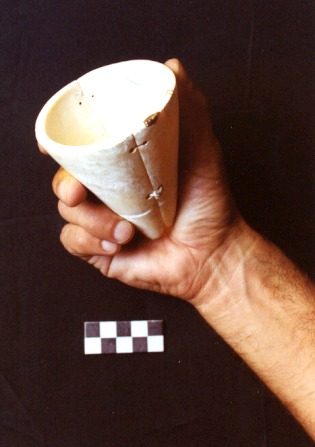
On the other hand, in this period the first appearances of Conus fergusoni are documented in sites of Vicús culture like Loma Negra and Pampa Juárez, located in an ecosystem more linked to the tropical atmosphere of the extreme of Peruvian north, department of Piura (Gorriti 2000: 17). Also, Moche culture continued with the use of Conus fergusoni as offering in funerals (for example in “Sipán Lord”, in Huaca Rajada) as well as representations in the iconography. This species of tropical mollusk has not been in contexts of the culture Lima or Nasca (Ibid.).
 |
 |
|
Figure 6. Conus fergusoni. Goblet made of Conus
fergusoni. National Museum collection.
|
|
Of the revision of the evidence we arrive to the conclusion that for the period of the Regional Developments the north coast of Peru was linked in a very near way to the areas of the Ecuadorian coast, habitat of the species of the molluscs here pointed out. A high fluency of very flowing exchange should exist among these areas. In contrast, the central coast and south coasts were far from having an easy access to these exotic molluscs. We do not find massive offerings of Spondylus princeps valves and Conus fergusoni either, as well as neither Strombus galeatus among the remains of Lima or Nasca cultures . When beginning the impact of the culture Huari in the central coast the Spondylus begins to be represented in sculptural bottles of double pick and roasts bridge of style Nievería (d'Harcourt 1922: Planche IV: 1, 7).
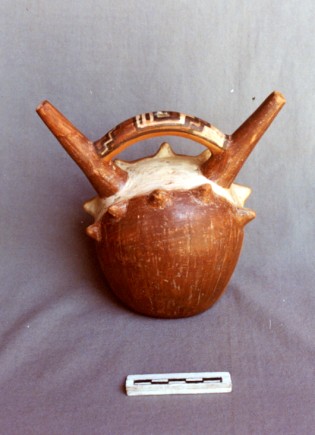 |
Figure
7. Nievería bottle with Spondylus. National Museum of Peru collection.
|
To finish, we want to point out that future studies of these big tropical molluscs will not be reached if the specimens are not identified accurately and the contexts are not published. Archaeologists must repair in this class of evidence in a more careful way.
National
Museum of Archaeology, Anthropology and History, Peru
Lima, September 2002.
Manuel Gorriti
Manchego:
E-mail: Gorritimanuel21@hotmail.com
Victor Falcon
Huayta:
E-mail:Vic1falcon@hotmail.com
BIBLIOGRAPHY
Alamo V. Y V. Valdivieso:
1997: Lista Sistemática de los moluscos marinos del Perú. Publicaciones Especiales Inst. del Mar del Perú, 183 pp, 406 figs.. callao-Perú.
Alva Walter
1986: “Cerámica Temprana en el valle de Jequetepeque, Norte del Perú”. Materialen zur Allgemeinen und Vergleichenden Archaologie, Band 32. AVA-Materialien. Verlag C.H.- Munchen..
Bonavía, Duccio
1982:Los Gavilanes. Mar, Desierto y Oasis en la Historia del Hombre. Cofide. Lima.
Bourget Steve
1990:“Caracoles sagrados en la iconografía Moche” Gaceta Arqueológica Andina. Vol. V, N° 20, pp. 45-58.
Burger, Richard
1992: Chavín and the Origins of Andean Civilization. Thames and Hudson. London.
1993:“Los Inicios de la civilización peruana y su relación con el Horizonte Chavín”. Emergencia de la Civilización en los Andes. Universidad Nacional Mayor de San Marcos. Pp. 23-39. Lima-Perú.
1998: Excavaciones en Chavín de Huantar. Pontificia Universidad Católica del Perú. Fondo Editorial. Lima-Perú.
d’Harcourt Raoul
1922; “La céramique de Cajamarquilla-Niveria”. Journal de la Société des Americanistes de Paris. Nouvelle série. T. XIV.
Feldman Robert Alan
1980: Aspero, Peru: Architecture, Subsistence Economy, and Other Artifacts of a Preceramic Maritime Chiefdom. Thesis. Department of Anthropology in partial fulfillment of the requirements for the degree of Doctor of Philosophy in the subject of Anthropology. Harvard University, Cambridge, Massachusetts.
Grieder Terence, Alberto Bueno Mendoza, C. Earle Smith, Jr., and Robert M. Malina
1988: La Galgada, Perú. A Precerámic Culture in Transition. University of Texas Press. Austin.
Gorriti Manchego, Manuel
2000:“Moluscos marinos: Spondylus, Strombus y Conus. Su significado en las sociedades andinas”. Boletín. Museo de Arqueología y Antropología. Publicación Mensual. Museo de Arqueología y Antropología. Centro Cultural de la Universidad Nacional Mayor de San Marcos. Año 3, N° 11, pp.10-21.
1992:“Análisis de artefactos en Spondylus procedentes de pueblo viejo(Nasca),contextos
ms. funerarios”. Manuscrito entregado al Lic. Mario Ruales.
Izumi Seiichi and Kazuo Terada
1972: Andes 4. Excavations at Kotosh, Perú 1963 and 1966. University of Tokyo Press, Tokyo.
Lavallée Daniele, Michele Julien y Jane Wheeler
1982: “Telarmachay: niveles precerámicos de ocupación”. Revista del Museo Nacional, T. XLVI, pp. 55-133. Lima-Perú.
Lumbreras Luis Guillermo
1989: Chavín de Huántar en el Nacimiento de la Civilización Andina. INDEA-CONCYTEC. Lima.
1993: Chavín de Huantar. Excavaciones en la Galería de Las Ofrendas. Verlag Philipp von Zabern. Mainz am Rhein.
Marcos, Jorge
1995:“El Mullu y el Pututo: La articulación de la ideología y el tráfico a larga distancia en la formación del estado Huanacavilca”. Primer Encuentro de Investigadores de la Costa Ecuatoriana en Europa. Alvarez, Aurelio et al. Compiladores. Pp. 97-142. Ediciones ABYA-YALA. Quito-Ecuador.
2002:“Mullo y Pututo para el Gran Caimán: Un modelo para el intercambio entre Mesoamérica y Andinoamérica”. Gaceta Arqueológica Andina. N° 26, pp. 13-36. junio, Lima-Perú.
Onuki Yoshio
1995: Kuntur Wasi y Cerro Blanco. Dos sitios del Formativo en el norte del Perú. Hokusen-Sha.
Quilter Jeffrey
1989: Life and Death at Paloma. Society and Mortuary Practices in a Preceramic Peruvian Village. University of Iowa Press. United States of America.
Ravines Rogger, Helen Engelstad, Victoria Palomino y Daniel H. Sandweiss
1982:“Materiales arqueológicos de Garagay”. Revista del Museo Nacional, T. XLVI, pp. 135-234. Lima –Perú.
Rick John
2001: http://www.stanford.edu/dept/anthsci/images.Rick-1
2002:Conferencia ofrecida en el Museo Nacional de Arqueología, Antropología e Historia del Perú, 10 de Septiembre de 2002.
Rojas Ponce Pedro
1969:“La Huaca Huayurco, Jaen Cajamarca”.Boletín del seminario de Arqueología. Publicación del Instituto Riva Agüero N° 63, pp. 48-56. Pontificia Universidad Católica del Perú.
1985:“La “Huaca” Huayurco, Jaen”. Historia de Cajamarca, I. Arqueología. Fernando Silva Santisteban et al. compiladores. Instituto Nacional de Cultura-Cajamarca. Corporación de Desarrollo de Cajamarca. Pp.181-186.
Rostworowski, María
1977: Etnía y Sociedad. Costa Peruana Prehispánica. Instituto de Estudios Peruanos. Lima.
1999: “Intercambio prehispánico del Spondylus”. SPONDYLUS. Ofrenda Sagrada y Símbolo de Paz. Fundación Telefónica y Museo Arqueológico Rafael Larco Herrera. Pp. 35-45.
Shady Solis Ruth
2000:“Sustento socioeconómico del estado prístino de Supe-Perú: Las evidencias de Caral-Supe”. Arqueología y Sociedad N° 13, pp. 49-66. Universidad Nacional Mayor de San Marcos. Lima- Perú.
Shady Solis Ruth, Haas Jonathan and Winifred Creamer
2001:“Dating Caral, a Preceramic Site in the Supe Valley on the Central Coast of Perú”. Science, Vol. 292, pp.723-726.
Silverman Helaine
1993: Cahuachi in the Ancient Nasca World. University of Iowa Press. Iowa City.
Stothert, Karen E.
1990: “La Prehistoria Temprana de la Península de Santa Elena, Ecuador: CULTURA LAS VEGAS”. Miscelánea Antropológica Ecuatoriana, Serie Monográfica 10. Museos del Banco Central del Ecuador. Guayaquil.
1988: Stumer Louis M.
1957:“Cerámica negra de estilo Maranga”. Revista del Museo Nacional, T. XXVI. pp, 272-289.
Tello Julio C.
1967: Paginas Escogidas. Selección y Prólogo de Toribio Mejia Xesspe. Universidad Nacional Mayor de San Marcos. Lima-Perú.
Terada Kazuo y Yoshio Onuki
1988: La excavaciones en Cerro Blanco y Huacaloma, Cajamarca, Perú, 1985. Andes Chosashitsu. Departamento de Antropología Cultural Universidad de Tokio.